General Approach
Patients with early pregnancy plus vaginal bleeding and/or pelvic or abdominal pain enter this pathway. The first question is not the exact diagnosis—it is whether the patient is stable.
1 Unstable?
- Unstable → resuscitate and identify the source of instability in parallel.
2 Where Is The Blood Going?
- Internal hemorrhage → ruptured ectopic pregnancy.
- External uterine hemorrhage → significant pregnancy loss.
- Sepsis → septic abortion.
3 Pregnancy Location
- Once immediate instability has been addressed, determine where the pregnancy is located with transvaginal ultrasound:
- Ectopic pregnancy.
- Pregnancy of unknown location.
- Intrauterine pregnancy.
4 IUP Status
- Once an IUP is identified, determine pregnancy status.
- IUP + cardiac activity + vaginal bleeding ± cramping → threatened miscarriage.
- If cardiac activity is absent or US findings are abnormal → determine whether:
- Too early / not diagnostic
- Concerning for EPL
- Diagnostic of EPL
- EPL in progress → GS in lower uterine segment / cervix, being expelled
- Incomplete EPL → residual intracavitary tissue ± persistent GS
- Completed EPL → no residual GS / tissue after known EPL
- Do not prematurely diagnose pregnancy loss from an early indeterminate US
- Finally, consider RhD/RhIg, disposition, and other causes of bleeding.
01Unstable / Major Hemorrhage?
Resuscitate
- Resuscitation and diagnosis occur together.
- ABCs / cardiac monitor / IV access.
- IV fluids while assessing the degree of blood loss.
- Blood products early if significant hemorrhage or shock.
- CBC and type and cross.
- Bedside FAST/POCUS looking for intraperitoneal free fluid.
- Urgent OB/GYN consultation whenever there is instability, major hemorrhage, suspected rupture, or septic abortion.
Critical Cause?
Ruptured Ectopic
- Bleeding internally.
- Abdominal / pelvic pain ± peritoneal signs.
- Hypotension / shock / syncope.
- FAST → free intraperitoneal fluid ± adnexal mass.
- Type & cross → transfuse as needed.
- Emergent GYN → OR.
- Do not delay operative management for formal ultrasound if crashing.
ACOG: tubal ectopic pregnancy with hemodynamic instability is a medical emergency requiring prompt surgical intervention. ACOG
Uterine Hemorrhage
- Bleeding externally.
- Heavy vaginal bleeding / ongoing blood loss.
- IV fluids / blood as needed.
- Urgent GYN.
- Ongoing hemorrhage / instability → uterine evacuation (D&C).
Septic Abortion
- Fever / chills.
- Uterine or pelvic tenderness.
- Foul / purulent discharge.
- Bleeding ± retained products.
- Sepsis / shock.
- Broad-spectrum IV antibiotics.
- Urgent GYN → uterine evacuation / source control.
02Where Is The Pregnancy?
Diagnosis: Pelvic / Transvaginal Ultrasound
- Pelvic US regardless of β-hCG level.
- Do not wait for the discriminatory zone before imaging.
- β-hCG helps interpret the pregnancy; does not determine whether US is obtained.
- Ectopic pregnancy can occur at any β-hCG level.
- Goal is finding the pregnancy location. Options:
- 1. Ectopic.
- 2. Pregnancy of unknown location.
- 3. IUP.
ACEP Level B: “Perform or obtain a pelvic ultrasound for symptomatic pregnant patients with any β-hCG level.” ACEP
Ectopic Pregnancy
Diagnosis: TVUS
- Definite ectopic
- Pregnancy implanted in an abnormal location.
- Yolk sac or embryo within the ectopic gestational sac.
- Probable ectopic
- Extraovarian / adnexal mass.
- Tubal / adnexal ring.
- No yolk sac or embryo seen.
- Other concerning findings:
- Complex adnexal mass.
- Free pelvic / intraperitoneal fluid.
- Hemoperitoneum.
- Free fluid or adnexal mass alone → concerning, not definitive. SRU 2024
Treatment Options
- Management → expectant vs methotrexate vs surgery, depending on clinical stability, symptoms, ectopic features, β-hCG trend, contraindications, and ability to follow up. ACOG: Tubal Ectopic Pregnancy ACOG: Ectopic Pregnancy
Expectant Management
- Selected stable, minimally symptomatic patients.
- No evidence of rupture / significant hemorrhage.
- β-hCG low and spontaneously declining.
- Reliable close follow-up required.
- Serial β-hCG until resolution.
- Worsening symptoms or failure to resolve → reassess treatment.
Methotrexate
- Selected stable, unruptured ectopic pregnancy.
- No significant symptoms suggesting rupture.
- No contraindication to methotrexate.
- Reliable follow-up required.
- Serial β-hCG until resolution.
- Inadequate response → additional treatment or surgery.
Surgery
- Hemodynamic instability / rupture.
- Significant or worsening pain.
- Significant hemorrhage.
- Contraindication to methotrexate.
- Failed expectant or medical management.
- Unable to reliably follow up.
- Ectopic features making medical treatment less appropriate.
- Patient preference / other GYN considerations.
Unstable / Ruptured Ectopic
- See Unstable / Major Hemorrhage above.
Pregnancy Of Unknown Location — PUL
Definition
- PUL = temporary diagnostic category, not a final diagnosis.
- Positive hCG + TVUS shows:
- no probable / definite IUP and
- no probable / definite ectopic pregnancy
- Possible outcomes:
- Early IUP not yet visualized.
- Ectopic pregnancy not yet visualized.
- Pregnancy loss
- Ectopic remains possible until location established or pregnancy resolves. SRU 2024
Workup
1. β-hCG 48 Hours
- Do not use a single β-hCG to determine pregnancy location.
- Repeat quantitative β-hCG in approximately 48 hours.
- hCG trend → helps determine pregnancy progression / next step, not location.
- Symptoms > hCG trend → new / worsening pain, bleeding, syncope → reassess immediately.
- Reliable close follow-up essential.
ACEP Level B: Do not use β-hCG to exclude ectopic pregnancy after an indeterminate TVUS.
ACEP Level C: Specialty consultation or close outpatient follow-up for all indeterminate studies. ACEP
Discriminatory Level — Pearl
- Not a diagnostic cutoff.
- Higher hCG + no IUP on TVUS → increases concern, but does not prove ectopic or pregnancy loss.
- Never intervene solely because hCG is above the discriminatory level and no IUP is seen. SRU 2024
Pitfall — “Complete Miscarriage”
- Empty uterus + history of bleeding / tissue passage does not prove completed pregnancy loss if an IUP was never previously documented.
- No prior confirmed IUP → remain in the PUL pathway until location or resolution is established ACOG
Intrauterine Pregnancy
1. Definite IUP
- Gestational sac in a normal intrauterine location + yolk sac or embryo.
- Cardiac activity is not required to call it a definite IUP.
2. Probable IUP
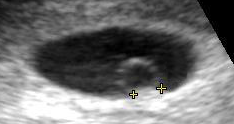
- Intrauterine empty gestational sac
- No yolk sac or embryo yet. SRU 2024
3. Heterotopic Pregnancy
- Remember heterotopic pregnancy if:
- assisted reproduction,
- significant risk factors,
- adnexal findings / free fluid,
- or the clinical picture remains concerning despite an IUP.
- Heterotopic pregnancy is rare spontaneously; increased with assisted reproduction. SRU 2024
03IUP Status?
Threatened Miscarriage
Concerning For Early Pregnancy Loss — EPL
Diagnostic Of Early Pregnancy Loss
EPL In Progress
- Gestational sac in lower uterine segment / cervix → in process of expulsion. SRU 2024
- If cardiac activity present → consider cervical or cesarean-scar ectopic rather than assuming miscarriage.
- Sliding sign / short-interval US may help if uncertain.
Incomplete EPL
- Residual intracavitary tissue ± persistent gestational sac after EPL. SRU 2024
- Thickened endometrium / internal vascularity may support diagnosis.
- Persistent bleeding / cramping common.
Completed EPL
Confirmed EPL — Management
- Stable / uncomplicated → expectant vs medical vs surgical management.
- Hemorrhage / instability / infection → urgent GYN + uterine evacuation. ACOG
04Final Steps
RhD / RhIg
- Determine Rh status when it may affect management.
- Rh-negative + unsensitized? → consider RhIg based on gestational age, diagnosis, bleeding / procedure, and current OB protocol.
- Very early pregnancy: recommendations vary and continue to evolve.
- Already sensitized → RhIg not beneficial.
Other Cause?
- If ectopic / EPL does not explain bleeding → consider subchorionic hemorrhage, vaginal / cervical source, molar pregnancy, other uterine pathology.
Disposition
- Unstable / ruptured ectopic / major hemorrhage / septic abortion → GYN / OR / admit.
- Stable tubal ectopic → expectant vs MTX vs surgery.
- PUL → reliable 48-hour β-hCG follow-up + repeat TVUS as indicated.
- Threatened miscarriage / uncomplicated EPL → outpatient OB follow-up when appropriate.
- Return precautions → worsening pain, syncope, heavy bleeding, fever.