Understanding the algorithm
General Approach To Acute Scrotum
Acute scrotum is a time-sensitive syndrome, not a diagnosis. First decide whether the pain is truly coming from the scrotum/testicle or is referred from the abdomen, flank, or groin.
If there is true acute scrotal pain, testicular torsion is the first diagnosis to exclude. High clinical suspicion should go directly to urology and surgical exploration; ultrasound is for an uncertain diagnosis and should never delay definitive care.
A useful way to think about the acute scrotum is:
- True scrotal source?
- Exclude torsion
- Torsion mimic?
- Other causes
01 True Acute Scrotum?
Examine
- Examine the testis, epididymis, spermatic cord, groin, scrotal wall, abdomen, and flank.
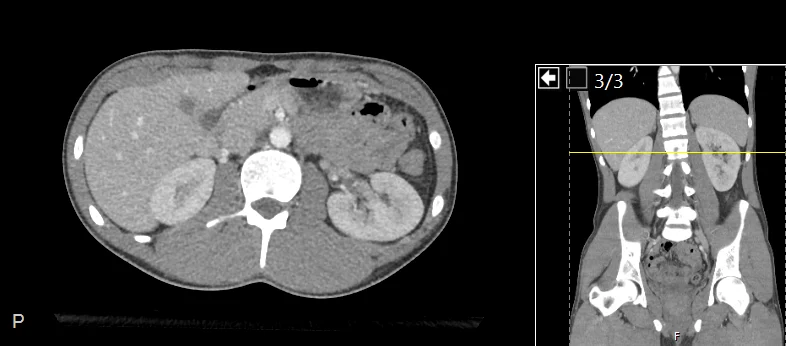
- A normal scrotal exam should push you toward referred pain: ureteral stone, appendicitis, or other abdominal/retroperitoneal pathology.
- Conversely, torsion can occasionally present as abdominal, groin, or flank pain. In a young male with otherwise unexplained lower abdominal/flank pain, examine the testicles.
02 Exclude Testicular Torsion
Testicular Torsion
History
- Torsion can occur at any age, with peaks in neonates and adolescents.
- Look for sudden, severe unilateral scrotal pain.
- Nausea and vomiting may accompany the pain.
- Abdominal or flank pain may be the presenting complaint.
- Recurrent episodes that suddenly resolve suggest intermittent torsion.
Physical Exam
- Look for a high-riding testis.
- Check for a horizontal lie.
- An absent cremasteric reflex raises concern for torsion.
- Diffuse testicular tenderness and swelling may be present.
- Compare both testes.
- A present cremasteric reflex makes torsion less likely but does not exclude it.
TWIST Score — Optional Risk Stratification
TWIST CalculatorOptional torsion risk assessment
- The TWIST (Testicular Workup for Ischemia and Suspected Torsion) score can be used as an adjunct when evaluating suspected testicular torsion. See MDCalc — TWIST Score.
- Barbosa thresholds: A score of 0–2 is low risk, 3–4 is intermediate risk, and 5–7 is high risk.
- Journal Club — TWIST Meta-Analysis: Diagnostic performance: A 2022 meta-analysis reported approximately 98.4% sensitivity at the low-risk threshold and 97.5% specificity at the high-risk threshold. Qin and Qu, 2022
- Clinical limitation: That still leaves a risk of missed torsion in a time-sensitive diagnosis. A low TWIST score must not override a concerning history or exam. High clinical suspicion requires urgent urologic evaluation; calculating the score must not delay surgical exploration. EAU guideline
High Suspicion
- Arrange urgent urology consultation and surgical exploration.
- Do not delay definitive care for ultrasound.
- Keep the patient NPO, obtain IV access, and treat pain and nausea while the OR plan is being arranged.
Uncertain Diagnosis
- Obtain urgent Doppler ultrasound and spermatic cord imaging.
- Typical findings include:
- Decreased or absent intratesticular flow.
- An enlarged, edematous testis.
- A whirlpool sign from the twisted spermatic cord.
- Normal or increased Doppler flow does not exclude torsion, especially with early, partial, or intermittent torsion.
- Persistent clinical concern requires urgent urology despite a reassuring ultrasound.
Intermittent Testicular Torsion
- Intermittent torsion is torsion-detorsion: sudden severe unilateral pain that resolves spontaneously. After detorsion, the exam may improve and Doppler flow may return to normal or become hyperemic.
- Ask about prior identical episodes.
- Look for horizontal lie or a spermatic-cord whirlpool sign.
- Recurrent intermittent torsion requires urology evaluation and orchiopexy to prevent a future sustained torsion.
Manual Detorsion
- Manual detorsion may be attempted if there will be a meaningful delay to surgery.
- Usually rotate outward — “open the book.”
- If pain worsens or there is resistance, reverse direction.
- Pain relief or return of flow suggests successful detorsion.
- Successful manual detorsion does not eliminate the need for surgical exploration and orchiopexy.
Time Is Testicle
- Detorse as soon as possible. The best salvage is in the first 4–6 hours, but 6 hours is not a hard cutoff.
- 0–6 hours: Salvage is highest.
- 6–12 hours: Salvage remains substantial but is falling.
- More than 12 hours: The risk of testicular loss rises sharply.
- More than 24 hours: The prognosis is poor, but still obtain urgent surgical evaluation.
- Journal Club — Testicular Survival Review: A systematic review found testicular survival of approximately 97% at 0–6 hours, 79% at 7–12 hours, 61% at 13–18 hours, and 43% at 19–24 hours. Time affects the probability of salvage; it should not be used as a reason to withhold exploration.
Definitive Surgery
- A viable testicle requires detorsion and orchiopexy.
- The contralateral testicle is usually fixed at the same operation because the predisposing anatomy may be bilateral.
- A clearly nonviable testicle requires orchiectomy.
03 Torsion Mimic?
Epididymitis
Typical Clues
- The pain is usually gradual and progressive.
- Urinary or urethral symptoms or pyuria may be present.
- Look for focal epididymal tenderness and swelling.
Work-Up / Action
- Doppler may show epididymal enlargement and hyperemia, with or without increased testicular flow.
- Obtain urinalysis, urine culture, and STI testing as appropriate.
- Treat according to likely etiology, not age alone.
- For a prepubertal patient with no evidence of bacterial infection, provide supportive care.
Pitfall: With sudden severe pain or an equivocal presentation, keep torsion first until it is excluded.
Torsion Of Appendix Testis
Typical Clues
- The patient is often prepubertal.
- Acute scrotal pain is the presenting complaint.
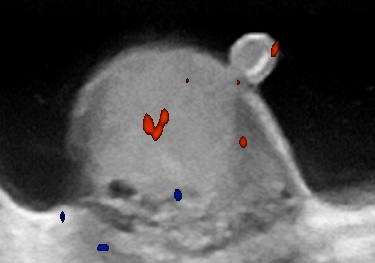
- Look for a blue-dot sign.
- A focal tender nodule may be present at the upper pole.
Work-Up / Action
- Ultrasound may show an enlarged avascular appendage at the upper pole, often with surrounding hyperemia; testicular flow remains preserved.
- Provide NSAIDs, rest, and supportive care.
- Surgery is needed only if the diagnosis is uncertain or pain persists.
Orchitis / Epididymo-Orchitis
- Isolated orchitis is less common than epididymo-orchitis.
- Viral symptoms, including mumps when epidemiologically plausible, may suggest orchitis.
- Doppler usually shows increased testicular blood flow.
- Viral orchitis is treated with supportive care.
- Bacterial epididymo-orchitis is treated according to the suspected infection.
04 Other Causes?
Incarcerated Inguinal Hernia
- Look for a painful groin or scrotal mass that is often nonreducible.
- Bowel symptoms or obstruction may be present.
- Concern for strangulation requires urgent surgical evaluation.
Fournier Gangrene
- Look for severe pain, skin changes, crepitus, and systemic toxicity.
- Obtain emergent surgical consultation and give broad-spectrum antibiotics.
Testicular Cancer
- The usual presentation is a painless intratesticular mass, but pain can occur.
- A solid intratesticular mass on ultrasound requires urgent urology evaluation.
- Obtain AFP, β-hCG, and LDH when cancer is suspected.
- Normal tumor markers do not exclude testicular cancer.
Other
- Trauma.
- Hydrocele.
- Varicocele.
- Idiopathic scrotal edema.
- IgA vasculitis (HSP).
High-Yield Pearls
- Acute testicular pain is torsion until proven otherwise.
- High suspicion requires urology and the OR; do not wait for ultrasound.
- Preserved Doppler flow does not exclude early, partial, or intermittent torsion.
- The whirlpool sign is an important direct clue to spermatic-cord torsion.
- Manual detorsion is a bridge to surgery, not definitive treatment.
- The clock matters, but late presentation is not a reason to withhold exploration.
Cases
Pop Quiz Hotshot
Must-Read References
View Full References
- Acute Scrotum Algorithm. The Chief Complaint. 2026.
- Feier C. The Chief Complaint: Emergency Medicine Handbook. 2014. Earlier chapter used for retained teaching pearls on intermittent torsion, spermatic-cord imaging, manual detorsion, and time-sensitive salvage.
- European Association of Urology — Acute Scrotum / Testicular Torsion.
- MDCalc — Testicular Workup for Ischemia and Suspected Torsion (TWIST).
- Qin KR, Qu LG. Diagnosing with a TWIST: Systematic Review and Meta-Analysis of a Testicular Torsion Risk Score. J Urol. 2022;208(1):62–70.
- CDC — Epididymitis STI Treatment Guidelines.
- NSW Agency for Clinical Innovation — Acute Scrotum.
- European Association of Urology — Testicular Cancer Diagnostic Evaluation.
- Mellick LB, Sinex JE, Gibson RW, Mears K. A Systematic Review of Testicle Survival Time After a Torsion Event. Pediatr Emerg Care. 2019;35(12):821–825.